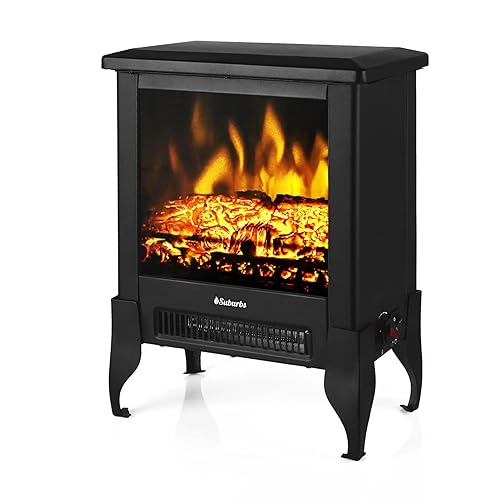
A plug-in electric fireplace and a plug-in space heater both run on standard household power, and both turn nearly all of that power straight into heat. At the same wattage, they put out the same warmth. FireplaceCompared.com tracks both product types the same way: by watts, by dollars per hour, and by what the listing actually promises versus what a 15 A outlet can deliver.
Do electric fireplaces heat as well as space heaters?
Yes, watt for watt. Electric resistance heat is close to 100% efficient, so a 1,500 W electric fireplace and a 1,500 W space heater convert the same amount of electricity into the same amount of heat. The difference is not heat output, it is price, size, portability and whether you also want a flame effect.
Electric fireplace vs. space heater, side by side
| Space heater | Electric fireplace | |
|---|---|---|
| Typical price | $25 to $120 | $130 to $1,500+ |
| Heater wattage (120V) | Up to 1,500 W | Up to 1,500 W |
| Realistic room coverage | 150 to 400 sq ft | 150 to 400 sq ft |
| Flame effect | No | Yes, most run flame-only without heat |
| Portability | Fully portable | Wall units are fixed; stoves and TV stands can be moved |
| Install | Plug in, done | Wall units may need a bracket; inserts need a measured opening |
| Looks | Utility appliance | Furniture piece or focal point |
Both product types cap out at roughly 1,500 W on a standard US 120V circuit, which works out to about 5,100 BTU/hr. A listing that promises a bigger room on either product is describing a best case, not a different heater.
What does each one cost to run?
At 1,500 W on full heat, both a space heater and an electric fireplace cost about the same per hour to run, since the cost comes from the wattage, not the cabinet around it. Our guide to electric fireplace running costs has the full math, including the much cheaper flame-only mode that only an electric fireplace offers.
A space heater has no flame-only mode, so turning it on always means paying for the heater. An electric fireplace left on with the heat switched off uses only the LED lights behind the flame panel, which is why owners often run the flames year-round and the heat only in winter.
Is an electric fireplace safer than a space heater?
Both are heater types that cause home fires when used wrong, and neither is automatically safer than the other. What matters is a UL, ETL or CSA safety listing, an overheat cut-off, and keeping the unit on a direct wall outlet with clear space in front of it, which our electric fireplace safety guide covers model by model.
A space heater's main added risk is that it is designed to be carried and placed anywhere, including on a rug, near bedding or close to curtains, which is also exactly how most heater-related house fires start. A wall-mounted or recessed electric fireplace cannot be dragged next to something flammable because it is fixed in one spot, but a freestanding electric stove or a portable infrared unit carries the same placement risk as a space heater and should be treated the same way.
When a space heater is the better buy
- You need heat in more than one room over a season and want to move it between them.
- Budget is under $100 and you do not care about the flame effect.
- You are heating a dorm room, a garage, or a short-term rental where mounting anything to a wall is not an option.
- You want the smallest, lightest unit you can find.
When an electric fireplace is the better buy
- You want a focal point in a living room or bedroom, not just an appliance.
- You plan to run the flame effect without heat for most of the year, which a space heater cannot do.
- You are furnishing a room and the fireplace doubles as a TV stand, mantel or built-in look.
- You want a fixed install that nobody has to remember to switch off before leaving the house.
Electric fireplace vs. space heater for a bedroom
For a bedroom, the usual advice tips toward the electric fireplace, but only for the reason that matters at night: a wall-mounted or recessed unit cannot be knocked over by a child, a pet, or a foot getting out of bed, while a tabletop or stand-up space heater can. If a bedroom is small, look for a narrower wall unit from our wall-mounted fireplace category rather than a wide one sized for a living room. Either way, nothing should run under a bed, inside a closet, or touching bedding.
Mistakes that cause fires with either one
- Extension cords and power strips. A 1,500 W heater draws about 12.5 A for hours at a time, which is more than most cords and strips are rated to carry continuously.
- No clearance. Most manuals call for about 3 ft of open space in front of the heater vent. Curtains, sofas and boxes count.
- No safety listing. If a listing does not name UL, ETL or CSA, treat that as a reason to look elsewhere, not a detail to skip past.
- Leaving it running unattended overnight on a non-thermostat model. Without a thermostat, either product keeps heating until someone switches it off.
- Buying by square footage promise alone. Both product types are usually the same 1,500 W heater regardless of the sq ft number on the box.
Picking between specific models
Our electric fireplace buying guide walks through type, size and controls in order. If budget is the deciding factor either way, our under $300 category lists electric fireplaces priced close to a mid-range space heater, and a model with a built-in thermostat, like the ones in our thermostat category, closes most of the running-cost gap between the two.
FAQ
Is a space heater cheaper than an electric fireplace? To buy, yes. Basic space heaters start around $25, while electric fireplaces start closer to $130 because you are also paying for the cabinet and flame display. To run, the two cost about the same per hour at the same wattage.
Do electric fireplaces use more electricity than space heaters? No, not at the same wattage setting. Both are capped at about 1,500 W on a standard outlet, and a watt is a watt regardless of which appliance it is heating.
Can an electric fireplace replace a space heater? For heating one room, yes. An electric fireplace heats the same way a space heater does, with the added option of running the flame display with the heater switched off.
Why do some electric fireplaces list a much bigger square footage than a space heater? Marketing, mostly. The heater inside is usually the same 1,500 W unit either way; a bigger square-footage claim describes a best-case, open-floor-plan scenario rather than a different heating capacity.
Is it safe to leave an electric fireplace on overnight? Only on a model with a thermostat and an overheat cut-off, and only on a fixed, wall-mounted or recessed unit rather than a portable one. Check the manual for the manufacturer's own guidance before doing this with any heater.
Which is better for a small apartment, a space heater or an electric fireplace? A space heater if you need to move heat between rooms and have no wall space to spare. A slim wall-mounted electric fireplace if you have one main room and want it to double as decor.
Do I need an electrician to install either one? No for a plug-in space heater or a plug-in electric fireplace. You only need an electrician if you choose a hardwired 240V electric fireplace or want a new outlet added behind a wall-mounted unit.